Showing posts with label psychology. Show all posts

Friday, October 24, 2025

The first time I opened the Akashic Records…

Photo credit: globalbizarre.com/what-are-the-akashic-records

The first time I opened the Akashic Records…

Love Notes

By Brynne E. Dippell, Ph.D.

Post on October 23, 2025


Hello! 

When I discovered the Akashic Records, my life changed completely.

I began my career as a psychologist, doing long-term intensive therapy. I loved working intimately with people to understand their inner worlds and guide them toward greater clarity, resilience, and self-awareness.

A spiritual awakening changed all of that in the blink of an eye. Within weeks I left the traditional practice of psychology and was called to blend my counseling skills with my newly opened intuitive abilities. A few years later, I had another overnight awakening when I encountered the Akashic Records. I knew instantly this was my soul’s divine purpose.

I still remember the very first time I opened the Akashic Records.

I had been preparing for weeks. I had asked the woman who introduced me to the Records to mentor me and teach me how to access this beautiful wisdom myself.  When the moment came, I was nervous. I wasn’t sure I was going to do it right.
I wondered if I would see something? Hear something? Would I notice anything at all?

I said the sacred prayer to access the Records and waited….

Something shifted.

The air became electric.

The space around me opened up into what felt like a vast temple.

And in that moment, I could feel an energy.

It felt like home.

It wasn’t a place outside of me, but a remembering inside me.

This was the first time I began to understand:
The Akashic Records aren’t “out there.”
They live within us.
They are the field of truth we already carry. They are the wisdom that has always been there, just waiting for us to access it.

That moment changed everything for me.

It began a way of living that was more connected, more trusting, and more aware of the Divine presence that had been with me all along.

If you have ever wondered if you can access the Akashic Records…

If you’ve questioned whether you’re “intuitive enough…”

Let this moment be your reminder - you already are.

The Akashic Records don’t ask you to become someone different.

They simply invite you to remember who you’ve always been.

Take a breath in.
Let us remember together now: You already have the connection you’re seeking.

The Akashic Records, your pathway to the Divine, live within you.

Whether you’ve been accessing the Records for years, or are just beginning to explore, every time you turn inward with intention, the door opens a little more.

This is only the beginning of what's possible for you. :)

Much love,


Brynne


  • The Illumined Heart, Inc.
  • Spiritual Guidance for Heart & Soul
  • www.brynnedippell.com
  • ⒸBrynne E. Dippell, Ph.D. 2025

Monday, February 24, 2025

Your Deeply Hidden Agenda

Your Deeply Hidden Agenda

Life Tapestry Creations

Channel: Brenda Hoffman

February 24, 2025


Dear Ones,

Even though your fears are partially the result of recent events, they are mostly the pent-up fears you have carried for 3D Earth eons.

You are reacting to fears beyond today’s reality. 

Every time you are accosted emotionally or physically in your current world, you are reminded of trauma that might have happened eons ago.

Reminders triggered daily by world events – not to relive them but to erase them from your memory.

You are in the midst of your private hell because you are tying current events to past trauma and releasing it.  You are the patient and the psychologist.

Even though you are in a releasing phase, which allows you to exit those long-held fears, the accumulation of all you are feeling internally is frightening, along with knowing your life as you knew it is over.

Of course, many of you have been releasing for months, years, or decades.  So you question why this particular time is so fearful, given all you have released.  This is so because the fears you release include elements you ignored or have been afraid to address.

Throughout the eons you have been of 3D Earth, you have been the power-broker, thief, war-monger, murderer, prostitute, compassionate and loving being, homeless person, warrior, and earthly saint.  You have experienced every piece of 3D fear-based humanity.  Something you have been afraid to address, given your need to move beyond 3D.

It is like young children refusing to admit they ate all the cookies despite the chocolate ring around their little mouths.  You might find that humorous as an adult even though you must address the issue.

You are now acting out both the child and parental roles, discovering pieces of yourself you have been ashamed of.  So you are angry at others, not because they have disrupted your life, but because they display pieces of yourself you have kept hidden for eons.

Even though this message does not apply to everyone, it applies to enough of you to arouse your curiosity or fears.  Allow yourself to flow through this piece as a reminder of how complex and, perhaps, in your vocabulary, evil someone can be, which is bringing up issues you have hidden for eons.

Perhaps you question that last statement, remembering that you have existed in other places at other times and believing the 3D “evils” becoming evident must have shifted within you at some point.

The other places and times you lived did not affect those 3D pieces because your role was to explore every 3D Earth experience possible before initiating this transition.  You needed to fully understand fear and allow yourself to cleanse during this time.  If you had only experienced love and joy, you would not understand why this transition was necessary or how to combat it.

Before you began this arduous transition journey, you knew you would experience fear by creating and experiencing it.  This historical time is tying it all together so that some days you are angry, others fearful, and still others calm and peaceful.  You are shedding your fear skin with all its secrets for a new skin that expects peace—an expectation that would not be possible if you maintained your hidden shame and fear.

You are exposing your positive and negative 3D hidden agendas, which are inconsequential in your new world.  But without this exposure, you would have difficulties fully claiming your new self.

Some of you are not experiencing anything unpleasant, while others are nearly incapacitated with shame and fear.  Everyone is addressing this phase in their unique fashion.  But know that none of you now transitioning has been what you consider a “good” person throughout your 3D Earth lives.

Those now of 3D display your worst 3D tendencies, forcing you to address your hidden agenda- issues you wish would remain secret forever.  

Hiding parts of yourself is not to be.  Not because you are terrible but because you wish to enter your new world with a clean slate. 

In 3D, you were neither a terrible nor a loving person; you were both because you were preparing yourself and the Earth for now.  You needed to experience pieces you hoped were hidden so deeply that you would never have to experience them again.

To find your path, you must eradicate those hidden secrets you have punished yourself with for eons.

It is time to allow yourself to love all of you.

So be it.
 
Brenda Hoffman
 
Copyright 2009-2023, Brenda Hoffman. All rights reserved. Please feel free to share this content with others, post on your blog, add to your newsletter, etc., but maintain this article’s integrity by including the author/channel:  Brenda Hoffman & source website link: 


Sunday, July 21, 2024

You Come Across As Rude If You Use These 6 Phrases

You Come Across As Rude If You Use These 6 Phrases

By Sherrie Hurd, A.A.

learning-mind.com

Posted on July 21, 2024


Did you know that if you use certain words, you may come across as rude? That’s right. So, it’s always important to think twice before speaking.

Most people aren’t trying to intentionally come across as rude, but they often end up saying something regretful. People make mistakes. It’s important to note that certain figures of speech may sound mean when used in a particular context.

You see, helpful communication requires more than just the ability to say what you think. In fact, communication is an art, easy for some, but difficult for others.

Be careful not to come across as rude

Yes, it is important to evaluate every word before speaking. This lowers the risk of saying something that may be misunderstood.

Trust me, I am an expert in shoving my foot in my mouth and coming off as rude. It’s easy to do, and that’s why you should always carefully mull over those quick-witted statements you’re getting ready to fire. Here are a few examples of phrases that may come off as being rude.

1. “Calm down”

While this may not sound all that rude at face value, saying this to someone can be condescending. In a way, it invalidates what someone may be going through. Instead of saying “Calm down”, maybe it would be better to just listen. Yes, your intentions may not be to upset them, but inadvertently, that’s what could happen.

2. “It is what it is”

This is an interesting one, seeing as I’ve often said it. However, I will need to think twice before saying this again, now don’t you think? With a little research, I’ve discovered that saying this is simply a substitute for telling someone to stop complaining.

It’s a statement of finality, that whatever the situation is, you cannot change it. It’s rude, and it’s insensitive.

3. “Yeah, right”

This is a phrase that’s easy to say. Many times we say this in conversations, not understanding its implications. It’s usually used as a loose form of sarcasm and used flippantly.

But although you may not mean anything hurtful by the statement, it can come across as rude. It’s also a condescending figure of speech that makes you look and sound like a jerk. Although it may be easy to throw this one out there, consider holding it back.

3. “I’m sorry you feel that way”

Instead of apologizing, many people just say this instead, and it can be so offensive. And why is it so bad, you might ask?

Well, it’s a way to keep from apologizing and to retain a sense of innocence. You’re basically placing the blame on someone else for what you’ve done. So, instead of saying this, maybe just craft a well-worded apology, and mean it when you say it.

4. “That’s so cute”

Unless you compliment someone on what they’re wearing or how they look, saying “That’s cute” may not be the best move to make. This is especially true if the other person is doing something serious or trying to solve a problem.

Telling them they are being cute can come off as rude. When you do this, you downplay the efforts of others and call them silly or childlike. You’re also insinuating that you could do a much better job.

5. “I thought you’d know this”

This or a similar phrase is seen often in the workplace. Although people work at different paces, it is common to hear this type of criticism. And no, it’s not constructive criticism. It actually can come off as rude.

Never assume that just because you can accomplish a particular task, everyone else will be able to do the same thing in the same amount of time. And never say this phrase as a way to make things easier. It doesn’t.

6.“I told you so”

And the last one is a well-known phrase we’ve all been guilty of using. Saying, “I told you so” is just a way to make fun of someone for a mistake and let them know that you were right. It’s a way to express how you think you’re better than they are.

No, it’s not funny. It doesn’t even have a good intention attached to it either.
How to not come across as rude

Now that you’re familiar with a few rude phrases, you can transform your vocabulary to uplift others. It’s smart to practice being a better human, using kind and genuine phrases. Remember to steer clear of condescending statements and think before you speak, using introspection to filter your responses.

If someone is targeting you with rude statements, it’s okay to let them know you’re uncomfortable with what they say to you. Set verbal boundaries and stick with them.

No one will respect and love you in the same way that you love yourself. Keep this in mind. It is up to you to stand up for yourself and set the standard for how you want to be treated.

I wish you all the best in your endeavors.

Sherrie Hurd


About the author:
 

Staff writer at Learning Mind
Sherrie Hurd is a professional writer and artist with over 20 years of experience. As a survivor of childhood trauma and multiple types of abuse, she is an advocate for mental health awareness. Sherrie manages multiple mental illnesses, including anxiety disorder, bipolar disorder, and PTSD. With this background and personal experience, she strives to help others overcome trauma and abuse, cope with mental illness, and heal over time.

Copyright © 2012-2024 Learning Mind. All rights reserved. For permission to reprint, contact us. 
 

Saturday, April 6, 2024

84 Backhanded Compliment Examples That Are Insults

 84 Backhanded Compliment Examples That Are Insults

(and How to Fight Back!)

By Janey Davies, B.A. (Hons)

Posted on April 6, 2024
 
 
Featured image by benzoix on Freepik


A friend of a friend once described me as ‘not unattractive’. I wondered, is that a compliment? What does it actually mean?

If I’m not unattractive, then surely, I’m attractive. But why phrase it that way? Maybe he didn’t want to compliment me. Either way, it sounded like a backhanded compliment to me.

But hey, listen, it was years ago; I’m really not that bothered. To prove how not bothered I am, here are 84 backhanded compliment examples.

What Is a Backhanded Compliment?

Before I start, what is a backhanded compliment? Backhanded compliments are insults disguised as compliments. Some are obvious, others are more thinly veiled.

I’ve searched the internet for the best examples of backhanded compliments.

84 Backhanded Compliment Examples
  1. “Gosh, I wish I could be so relaxed about housework.”
  2. “You know a lot for someone who doesn’t read.”
  3. “What’s a girl like you doing in a nice place like this?”
  4. “I met your kids today. They’re actually really polite.”
  5. “You’re so lucky you have time to spend on a manicure.”
  6. “You know, it wouldn’t take much decorating to get your house looking lovely.”
  7. “I wish I had the confidence you do to dress like that.”
  8. “Wow, those jeans really flatter your wide hips!”
  9. “You’re attractive for an older woman.”
  10. “Don’t worry, it doesn’t matter how you look. Lots of girls like nice guys.”
  11. “I’ve seen smaller.”
  12. “How on earth did you pay for that truck?”
  13. “I can see how people may find you attractive.”
  14. “You’re so lucky you don’t have to work.”
  15. “Nice glasses! They totally make your nose look way smaller.”
  16. “You look skinny when you hold your head up.”
  17. “You’re such a hard worker. I could never leave my children with a sitter for that long.”
  18. “You’d be a catch if I didn’t know you.”
  19. “I love your car! My first car was that model.”
  20. “Did you do something different? You look good TODAY.”
  21. “I really enjoyed talking to you. I thought it was gonna be awful.”
  22. “I wasn’t expecting you to be so articulate, considering your background.”
  23. “I like the way you look; I don’t think thin girls are attractive at all.”
  24. “I would never have guessed you lived in such an affluent area.”
  25. “Wow, your skin looks so much better.”
  26. “Aww. You’ll be a great mom.” (not pregnant)
  27. “That’s not the ugliest shirt I’ve seen you wear.”
  28. “I think it’s lovely you’ve finally found someone who accepts you the way you are.”
  29. “You look really nice in this light.”
  30. “I love your mustache!” (to a female)
  31. “You know, you’d actually look quite sexy if you lost a few pounds.”
  32. “I just feel so much smarter after talking with you.”
  33. “I really admire how you don’t let housework stop your exercise regime.”
  34. “You’ve got such strong features.”
  35. “Your haircut really slims your face.”
  36. “You might not be the prettiest, but you’re definitely the funniest girl I’ve dated.”
  37. “You look amazing for someone that doesn’t wear makeup.”
  38. “Well, you’re not the ugliest girl I’ve ever seen.”
  39. “Your English is amazing.”
  40. “What’s a smart guy like you working in a company like this?”
  41. “You know, you’re pretty smart. I don’t care what other people say.”
  42. “You’re so funny! But looks aren’t everything…”
  43. “You’re really fast for your weight.”
  44. “Thank you so much for dinner; my grandparents used to make that when they were hard up.”
  45. “Your pimples have really cleared up.”
  46. “You look really pretty in that picture. It doesn’t even look like you.”
  47. “What you lack in grace, you make up for in eagerness.”
  48. “You look good today. I almost didn’t recognize you.”
  49. “It’s a good thing you’re pretty.”
  50. “How did you get a job in that company? I hear they’re really picky.”
  51. “I could never spend that much time on my appearance. I’m way too busy.”
  52. “You couldn’t have done better.”
  53. “It’s tough to underestimate you.”
  54. “I always feel more intelligent after reading your work.”
  55. “Hey, that’s a nice sweater! Do they make it in your size?”
  56. “Don’t worry, you’re pretty on the inside.”
  57. “You’re the sharpest bulb in the box!”
  58. “You’re so lucky you don’t have any responsibilities.”
  59. “You are a perfect example of how hard work and talent aren’t essential for success.”
  60. “I love how you just wear anything.”
  61. “Nice dress! Is it homemade?”
  62. “You’re a much better kisser than your brother.”
  63. “Oh hey, you’ve lost so much weight! I wouldn’t have recognized you if not for those awful jeans.”
  64. “You look just like your sister. She has a big chin too.”
  65. “That dress wouldn’t work on me; I don’t have the curves for it.”
  66. “I hope your future is as pleasant as you are.”
  67. “You’re so lovely when you make the effort.”
  68. “Well, I’ve taken up enough of your time…and vice versa.”
  69. “I actually want to marry you one day. You’re just so tolerable!”
  70. “You’re so brave to go back to work and leave your baby with strangers.”
  71. “You look like a hundred bucks.”
  72. “You’re lucky you have tiny boobs, or you’d look like a slut.”
  73. “I think you do really well with what you have.”
  74. “The back of your hand is beautiful!”
  75. “I like your outfit. It matches today.”
  76. “She is SO FUNNY when she’s drunk.”
  77. “Wow, you’ve got great makeup skills!”
  78. “You’re not the ugliest girl I’ve dated.”
  79. “I love that you’re not that skinny.”
  80. “I hope you have the day you deserve.”
  81. “I’d never be able to pull off that outfit!”
  82. “You would make a great plus-size model.”
  83. “You have no etiquette or sophistication, but I like that about you.”
  84. “I promise, I did not mean to accidentally insult you.”

How to Respond to a Backhanded Compliment?

You may recognize some of the backhanded compliment examples above, but don’t know how to respond. Here are four ways to tackle them.
Call it out

If you feel able to, call out the backhanded compliment. One way to do this is to acknowledge the compliment part of the comment, then address the insult. For example,

“You’re such a hard worker, I could never leave my children with a sitter for that long,” respond with “Thank you for noticing I’m a hard worker, but your comment about leaving my children is hurtful,” or, “Do you realize what you’ve said is not complimentary?”

Or, have a look at these clever comebacks.

Ignore it


Some of us don’t feel confident enough to call out unacceptable behavior, so ignoring a backhanded compliment can be an excellent tactic. It doesn’t mean you’re letting someone insult you and get away with it. You’re saying,

“I don’t value your opinion, so it doesn’t even require a response.”

You can also change the subject to make your point.

Say ‘thank you’ to the compliment part

There are people who use backhanded compliments to elicit a response. You can ignore these people or thank them to shut them down. You don’t have to respond or justify your actions if they’re being deliberately rude.

Acknowledge the positive part of the comment as if you haven’t heard the insulting bit.

Find the humor

Finally, I recommend fighting back with humor. Take the insulting part and magnify it out of all proportion. For example,

“You look good in this light,” you can respond with, “I know! I specifically asked them to use soft lighting!”

Final Thoughts

Do you know any backhanded compliment examples? Has someone given you a backhanded compliment? Let me know in the comments section.

References:

Janey Davies
 
 
Sub-editor & staff writer at Learning Mind
Janey Davies has been published online for over 10 years. She has suffered from a panic disorder for over 30 years, which prompted her to study and receive an Honours degree in Psychology with the Open University. Janey uses the experiences of her own anxiety to offer help and advice to others dealing with mental health issues.
 
Copyright © 2012-2024 Learning Mind. All rights reserved. For permission to reprint, contact us.
 

Sunday, March 3, 2024

If You Tolerate These 8 Behaviors, You Lack Self-Worth

If You Tolerate These 8 Behaviors, You Lack Self-Worth

By Sherrie Hurd, A.A.

learning-mind.com

Posted on March 3 2024


How do you know if you lack self-worth? Well, sometimes it’s obvious by all about the behaviors you tolerate. It’s time to do inventory, don’t you think?

Being a tolerant person is okay when you’re trying to understand another person and their perspective. But it reveals that you lack self-worth when you start tolerating all behavior. You see, it’s important to guard your mental health, and part of that is not tolerating certain behaviors that prove to be toxic.

Revealing your lack of self-worth

To gauge your most accurate level of self-worth, it’s important to recognize what behaviors you’re accepting from friends, family, and loved ones. This also applies to coworkers as well, as your work relationship can be toxic.

If you’re giving others control of your self-esteem, you’re devaluing yourself. Here are some behaviors you may tolerate which reveal that you lack self-worth.

1. Verbal abuse

If you allow someone to speak to you in any way they please, then what does that say about how you view yourself? If a partner yells and you just stand there and take it, then something is wrong. Could it be that you think you deserve such garbage? Well, you don’t, and if this is happening, then put a stop to it.

Hopefully, you can walk away when the verbal abuse starts. Maybe you can even rethink your relationship. With family and friends, this applies in the same way. Do not tolerate verbal abuse.

2. Compromising your needs

Are you always the one who sacrifices what you want for someone else’s interests? If so, you may tolerate their selfish or pushy behavior because you don’t think what you want matters as much. It’s all part of having that lack of self-worth.

The healthy way to go about this situation is to be assertive in what you want, showing that your needs are just as important as what someone else’s needs. Too much compromise can kill your dreams and your self-worth.

3. Disrespect

Tolerating disrespect reveals many things about yourself. First, it shows your lack of self-worth. It also reveals your inability to say “No”. Yes, sometimes when you go along with everything, it means you cannot set clear boundaries in your life.

Everyone needs healthy boundaries to understand what should and should not be tolerated. So, to begin, practice saying “no”, and then all the rest will fall in place. Disrespect includes behaviors such as lying, talking behind your back, and invading your privacy, just to name a few.

4. Negativity

We all have that one friend who’s constantly spreading negativity. And we may feel like it’s important to remain friends with them because maybe others will not.

Unfortunately, negativity spreads, and when we tolerate this influence in our lives, it shows that we lack basic self-worth. Although trying to be kind to negative people is good, it’s also okay to love them from a distance. It’s not our job to fix them, it’s our job to fix us.

5. Constant criticism

We lack self-worth if we allow constant criticism. It’s not okay to let others consistently degrade or belittle us or the things we do. While not everything we do may be good for us, constant criticism is worse.

So, to heal our unhealthy self-esteem, we must limit our time around those who always put us down somehow. We can appreciate the good things about ourselves.

6. Manipulation

Manipulation comes in many forms, including gaslighting. I mention gaslighting because it is an especially toxic and powerful tool to bring down a person’s sense of self. If you tolerate such behavior, you already have a lack of self-worth, and have probably fallen victim to multiple instances of gaslighting.

To break this pattern of manipulation, you may have to remove yourself from the people who do this to you to see the truth. You are worthy. Never think otherwise.

7. Controlling behavior

Allowing controlling behavior is saying that you don’t feel confident in making your own decisions. This will continue as long as you feel this way. Some people sense your lack of self-worth and they use this to control everything you do.

This could come from parents, partners, friends, and many other people in your life. Having control over another person is powerful, but taking back control of your own life is even more powerful.

8. Ignoring boundaries

If someone crosses your boundaries, and you don’t say something to them, then you may lack self-worth. Maybe this person, whether a friend or family, thinks they have a right to cross these boundaries.

For example, even if your partner touches you and you don’t want to be touched, that is also crossing boundaries. Most people in relationships don’t realize this. You must have a strong sense of self to recognize this and speak up.

Repairing your self-worth

I mentioned a few things you could do to stop tolerating inappropriate behavior, but there are so many other things you need to keep in mind. It doesn’t matter what others think about your needs, boundaries, choices, or preferences, they’re important.

If you feel uncomfortable, say something. If you feel extremely uncomfortable, leave the location if you have to. But make sure you assert your self-worth as long as you are in a safe location.

I know there are instances where you cannot say or do things for fear of being berated or possibly hurt, but when the time comes, do what you need to do. The main point is to protect your self-esteem, and one day you can break free from the behaviors that enslave you.

Go forth, be you, and be free.

Sherrie Hurd

About the author:
 

Staff writer at Learning Mind
Sherrie Hurd is a professional writer and artist with over 20 years of experience. As a survivor of childhood trauma and multiple types of abuse, she is an advocate for mental health awareness. Sherrie manages multiple mental illnesses, including anxiety disorder, bipolar disorder, and PTSD. With this background and personal experience, she strives to help others overcome trauma and abuse, cope with mental illness, and heal over time.

Copyright © 2012-2024 Learning Mind. All rights reserved. For permission to reprint, contact us. 
 

Monday, February 26, 2024

7 Struggles Unloved Sons Have Later in Life

7 Struggles Unloved Sons Have Later in Life

By Sherrie Hurd, A.A.

learning-mind.com

Posted on February 26, 2024


Adult men struggle in many ways due to being unloved as a child. These issues can range from minor to completely unbearable, adding anxiety and toxic behavior to the ordinary stressors of life.

There are many forms of childhood mistreatment, including physical and mental abuse. However, it doesn’t seem like we’ve analyzed childhood neglect properly.

Neglect can be intentional and unintentional. First off, you could be a man who experience neglect as a child, but it was only due to the immature parenting and selfishness of your family. Then again, you could have experienced intentional neglect and a lack of basic love.

Unloved sons and their difficulties

Being unloved as a child can be devastating in adulthood. Relationships, jobs, and friends can all be affected by your past. It’s important to understand where certain feelings come from – your roots – but it is also important to recognize the cause of your present struggles. So, what are some struggles that unloved sons deal with in adulthood?

1. Drawn to toxicity

Unloved sons struggle with toxic relationships in adulthood. You see, they subconsciously seek out unhealthy partnerships because they are familiar with the traits exhibited by the object of their affection. These traits resemble some of the same characteristics that they experienced from their caregivers in childhood.

The brain recognizes patterns and follows these patterns because it seems ‘normal’ and familiar. The brain of an unloved son matches memory with outside stimuli. In layman’s terms, men seek the same form of relationship that they had in childhood, which was also unhealthy. Until they recognize the pattern and understand its harmful, it will repeat.

2. Depression and anxiety

It’s not surprising that men with depression or anxiety have a history of being neglected as a child. Being neglected and unloved as a child, and not healing from this, can cause severe negative feelings that lead to depression. It can also cause unwarranted fears and anxious behaviors, as unloved sons are constantly afraid of being neglected again.

3. Trust issues

If you were an unloved son, you probably struggle with trust issues. Every time you’re asked to trust someone, it feels almost impossible to do so.

Let’s consider this: your own mother, father, or other family members couldn’t even cultivate a healthy attachment with you. And so, they couldn’t be trusted to love you unconditionally. And so, in adulthood, trusting another individual with other things can be one of the most difficult tasks in the world.

4. Codependency issues

Suffering from neglect in childhood can cause severe codependency issues as an adult. You see, codependency is when you feel like you cannot function properly unless you’re attached to another person. And this is not a healthy attachment, it’s an obsessive type of attachment, as you’re trying to develop a strong bond that you didn’t have as a child.

Unfortunately, this attempt at bonding goes overboard creating strong codependency – you base every aspect of your life according to another person.

5. Feeling isolated

Some men choose to be alone, and that’s perfectly fine. However, there are others who isolate themselves because they believe forming bonds is impossible. This means having few to no friends, staying away from family members, and never getting romantically involved.

It’s kind of the opposite reaction to codependency. Instead of becoming overly attached, isolated men believe that since they were unloved in childhood, they are better off alone in adulthood. While introversion is not unhealthy, isolation can be. This is because there are different motivations and reasons behind these choices.

6. Insecurity

Men struggle with insecurity, sometimes on chronic levels.

Due to the absence of love in childhood, a boy’s self-esteem can drop so low that they develop narcissistic behaviors well before adulthood. This continues to develop into a false sense of security. This faux security serves as a mask to cover true insecurities developed from neglect. This type of insecurity can manifest in lying, anger, and deception, causing problems at work and in relationships.

7. Fear of failure

When sons are unloved, they grow up feeling like they’ve failed their families. So, to avoid further failures, they tend to exhibit strange traits. Fear of failure, when it comes to men, manifests as ‘playing it safe’, where instead of taking risks, these individuals only do what’s easy.

Fear of failure also manifests in ‘shifting of blame’, where they are never willing to take responsibility for their actions or mistakes. A man who suffered from neglect feels that if he admits to making a mistake, he will be unloved again. This cannot happen.

Unloved sons can become unloved men

Unfortunately, the struggles of adult men who were neglected as children can hurt them in permanent ways. Personality disorders are common results of childhood trauma, and these disorders can further isolate men from others.

The negative traits that arise from some of these struggles can drive others away and cause monumental damage. Adults who do not seek help for these issues will believe their own lies and decline rapidly as a result of their struggles.

If caught in childhood, the scars of neglect can be reversed. Just keep in mind, that the longer a son goes unloved, the more likely the man will become intolerable and miserable in adulthood.

Let’s put a stop to childhood neglect.


Sherrie Hurd

About the author:
 

Staff writer at Learning Mind
Sherrie Hurd is a professional writer and artist with over 20 years of experience. As a survivor of childhood trauma and multiple types of abuse, she is an advocate for mental health awareness. Sherrie manages multiple mental illnesses, including anxiety disorder, bipolar disorder, and PTSD. With this background and personal experience, she strives to help others overcome trauma and abuse, cope with mental illness, and heal over time.

Copyright © 2012-2024 Learning Mind. All rights reserved. For permission to reprint, contact us. 
 

Sunday, January 28, 2024

10 Truths about People Who Can’t Apologize

10 Truths about People Who Can’t Apologize

By Sherrie Hurd, A.A.

learning-mind.com

Posted on January 28, 2024


Have you ever met someone who seemed incapable of apologizing about anything? I think we all have. There are truths about people who can’t apologize, and it may surprise you.

Okay, here’s the truth about all of us. We all, every single one of us, have instances where we do not want to apologize to someone. This could be simply because we dislike the person we’ve slighted, or we see no point in an apology.

If we don’t like someone we bump into, some of us will just keep walking. If we make mistakes on paperwork, and our employer makes us aware of this, we may not see a need to apologize – we just fix the mistake.

People who can’t apologize: The truth

However, apologies do not mean we are weak. They show that we are strong enough to take the hit to our self-esteem. Let’s take a look at a few truths about people who cannot say they’re sorry.

1. Fear of imperfection

Many people choose not to apologize because they have a fear of not having a flawless character. First of all, none of us are perfect, but some people want to be seen this way. This is because they have horribly wounded self-esteem. And when the self-esteem is this low, the more the image will need to appear perfect. Apologizing for a mistake means imperfection.
2. Fear of weakness

Slightly different from the fear of perfection, the fear of weakness can cause people to lash out as well as refuse to apologize. The idea that they’ve made a mistake, to them, means they are weak. So, to remain strong, they must hold back the apology and continue as if nothing happened.

This will often come with deflecting blame to someone else. It’s usually the person that deserves the apology, and yet sometimes, anyone can be a scapegoat.

3. Create a chaotic environment

There are those who enjoy living in a chaos-filled environment. These individuals will not apologize as this creates peace and harmony after wrongdoing. Many people who suffer from a narcissistic personality disorder or sadism revel in leaving out apologies. It isn’t much you can do to convince these personalities that they should apologize. Only they can change their actions.

4. They are oblivious

You have some people who lack social cues, and these individuals may fail to apologize when they should. Maybe they weren’t taught in childhood that it’s wrong to interrupt people constantly during conversation and then not recognize their fault.

Maybe they failed to learn that being blunt takes tact, and feelings can be hurt. Listen, some people just have no clue when to apologize. But this still doesn’t make it your job to teach them. If you notice it and feel like helping them, you can, however.

5. Neither party wants to be first

Sometimes people don’t want to apologize because they don’t want to be the first one to admit guilt.

Let’s say an incident happened at a party and more than one person was involved. It would seem to someone with healthy self-esteem that all parties should be upping an apology, right?

Well, sometimes, no one wants to be the first one to admit their mistakes and so apologies fail to happen. Eventually, one person within the group will offer an apology, and this will be the strongest in the bunch.

6. Separating the character from the action

Here’s an interesting take on the matter. Did you know that non-apologists have trouble separating what they’ve done wrong from who they are? It’s true, some people fear that if they’ve done something bad, then they must be a bad person. And, of course, most of us know that this is far from the truth. We’ve all done ‘bad’ things.

7. Fear of revenge

Apologies will not come from someone who is afraid of retaliation. Believe it or not, some individuals think that if they lose something belonging to a friend, that friend will do the same to them in return.

But mentally healthy people do not retaliate. Something inside the non-apologist’s head tells them to not only refuse an apology, but try to hide what happened, pretend it never happened, or blame it on someone else.

8. Fear of loss

Sometimes people will not apologize out of the fear of losing a friend or loved one. And, of course, this is the opposite of what you should do. However, in the non-apologist mind, they see apologizing as further hurting the victim. As, apologies, in a sense, replay what happened.

9. Some are just plain stubborn

When it comes to apologies, some people are just too stubborn to admit mistakes. It could be about shame or resentment, or it may even be about an inflated ego – some people refuse to humble themselves. In this case, it’s best to leave them alone.
10. Apologies and toxicity

There are instances where people don’t apologize because they are afraid it will bring up other things they’ve done wrong. This dynamic sounds strange, but it happens.

Not all people who can’t apologize have low self-esteem or chronic issues. Sometimes they stop apologizing because it gets them nowhere with the other person. Sometimes the victim of wrongdoing has toxic traits and uses apologies as leverage. Many people stop apologizing to those who use them.

Let’s appreciate apologies

Although there are many reasons why people don’t apologize, there are facts and experiences that may even question whether saying your sorry is even worth it. Well, it is.

Being able to say you are sorry for something you’ve done wrong says so much about your integrity. You are strong, you have healthy self-worth, and you’re willing to put others first. So, keep apologizing, even if it’s difficult. You will be rewarded for your good heart.

Sherrie Hurd

About the author:
 

Staff writer at Learning Mind
Sherrie Hurd is a professional writer and artist with over 20 years of experience. As a survivor of childhood trauma and multiple types of abuse, she is an advocate for mental health awareness. Sherrie manages multiple mental illnesses, including anxiety disorder, bipolar disorder, and PTSD. With this background and personal experience, she strives to help others overcome trauma and abuse, cope with mental illness, and heal over time.

Copyright © 2012-2024 Learning Mind. All rights reserved. For permission to reprint, contact us. 
 

Tuesday, January 16, 2024

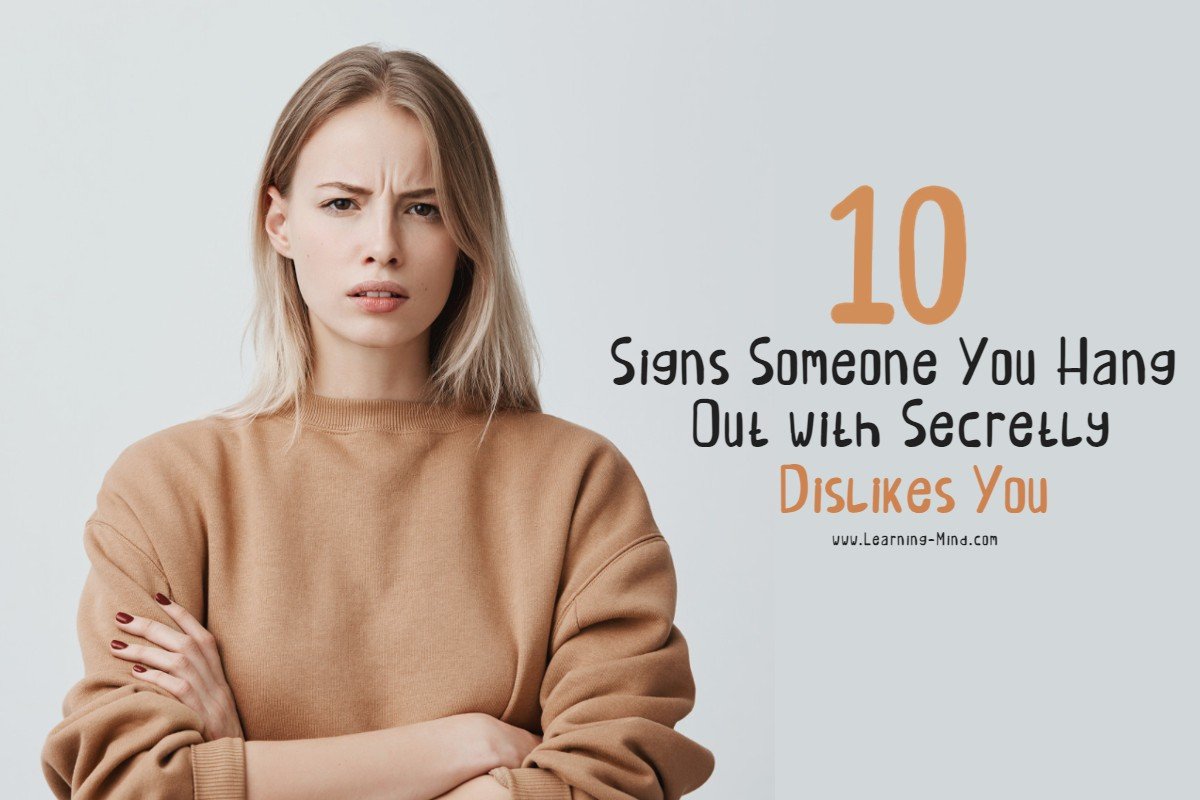
10 Signs Your Friend Secretly Dislikes You

10 Signs Your Friend Secretly Dislikes You

By Sherrie Hurd, A.A.

learning-mind.com

Posted on January 16, 2024


If a friend is sending a bad vibe or seems a bit off, could it be that this person secretly dislikes you? It can be true. Sometimes friends aren’t what they seem.

When someone secretly dislikes you, know this: they are sending signals. The problem is that you might not be getting the hint. Sometimes they show their distaste for you in subtle ways. Yet sometimes, they are obvious about their hatred. So, how can you determine the truth?

Signs someone secretly dislikes you

Well, there are several ways to determine if someone secretly dislikes you. They may send weird vibrations or they may make jokes that are actually passive-aggressive statements.

There are so many ways to discover that your friends or family members don’t like you. Here are 10 signs to help you weed them out:
1. They do not smile at you

This may seem petty, but it can be a sign. You will notice that a person may smile at everyone else, but when they turn to you, the smile drops. This is a sudden indicator that something just isn’t quite right. You may also notice that they carry a scowl on their face.

Sometimes people have bad days, but if they always frown in your direction, they probably don’t like you as much as you thought.

2. You’re excluded from conversations

Have you ever tried to talk to one particular person in a group of people, and this person completely ignored you?

Well, that happened to me a couple of weeks ago. This lady spoke to everyone else in the group, and when I asked her a question, she looked me right in the face and turned away. So, to check this, I spoke to her again. The same thing happened.

When someone secretly doesn’t like you, they will pretend like you don’t exist and refuse to include you in conversations.

3. They mock you

One thing that can be worse than being ignored is being mocked. When someone secretly dislikes you, they will make fun of you. There could be a couple of reasons for this. Maybe they feel threatened by you and they’re trying to bring you down. Or your presence could irritate them.

If you have a friend who does this, consider that they may not like you as much as you like them.

4. Strange eye contact

If a person has trouble making eye contact with you, then they may not like you. This is even true when it comes to family members. On the other hand, some people make hard steady eye contact that verges on the confrontational. It seems aggressive.

Either the lack of or too much eye contact can be a problem. Maybe they are pretending to be someone they’re not, which means they’re not your friend.

5. You’re getting back-handed compliments

Do you know what a back-handed compliment is? Well, in case you don’t, let me explain. A back-handed compliment is when someone seems to say something nice to you but always has to add a negative aspect to the compliment. For instance,

“You’d look great if you lost a little weight”, is a back-handed compliment.

And guess what, those who pretend to be your friend will often do this. Have you heard these types of things before? If so, you should do a friendship inventory.

6. They’re spreading rumors about you

It hurts so much when you find out that a friend is spreading horrible rumors about you. Well, let me tell you the truth. That’s not really your friend. When a person spreads rumors about you, it should be obvious that this is someone who secretly dislikes you. Because a person who really likes you would never do that.

7. They make excuses to never socialize

It’s normal to cancel plans every once in a while, but when a person cancels all the time, you may start to wonder if they even like you at all. Chances are, they don’t.

I cannot say 100% that people who cancel spending time with you are fake friends. It could be that things just keep happening. But, if you pair this with other signs, it could be that your “friend” secretly dislikes you.

8. They only share small talk

When someone secretly dislikes you, they will not share their personal issues or insight. No, they save that for those they really like.

For example, this person you think is your friend will only talk about the weather, the latest fashion, or food. A real friend will talk about their feelings, relationships, and even deeper things. While it’s not always true, this is a pretty good indicator.

9. Details about you don’t matter

True friends will remember the little things about you, like your birthday, hobbies, and interests. And yes, sometimes even genuine friends forget important dates. But those who pretend to like you will never really remember the most important aspects of your life, and this hurts.

When you seek support in difficult times, they won’t have a clue about your true character or how to help you.

10. They never initiate contact

Here’s a big one. And I bet some of you aren’t going to like hearing this, but oh well. Someone who secretly dislikes you will never initiate contact. You will always be calling them, texting them, or going to visit.

I venture to say that some of these fake friends aren’t even aware of what your house looks like or where you live. And I’m telling you, if they live around the corner, and they’ve never seen your place, I doubt they really like you. I know, right? Ouch!

Who are your real friends?

Those who like you will make sure you know that they do. While loyal friends sometimes do a couple of the things that I listed above, they are not consistently doing these negative things.

Life happens sometimes. However, if you have a friend who’s ticking off every one of these indicators, then beware. Please use these signs to discover who’s in your corner and who’s just using you. You might be surprised by what you find out.

I wish you the best.

Featured image by cookie_studio on Freepik 

Sherrie Hurd

About the author:
 

Staff writer at Learning Mind
Sherrie Hurd is a professional writer and artist with over 20 years of experience. As a survivor of childhood trauma and multiple types of abuse, she is an advocate for mental health awareness. Sherrie manages multiple mental illnesses, including anxiety disorder, bipolar disorder, and PTSD. With this background and personal experience, she strives to help others overcome trauma and abuse, cope with mental illness, and heal over time.

Copyright © 2012-2024 Learning Mind. All rights reserved. For permission to reprint, contact us.