Showing posts with label Secrets. Show all posts

Sunday, December 14, 2025

Spiritual Aliveness


Spiritual Aliveness

By Owen Waters

Post on December 14, 2025


Spiritual aliveness is the result of making your spirituality the day’s number one priority. Achieving this is fairly simple – as simple as being aware of one or two secrets of the universe and then setting your intention for each day.

Life is an expression of your spiritual self. You are here to gain experience on a grand scale. The small details of daily existence may not seem important, but they are all threads in the grand scheme of the life that you, as your inner self, planned before you were born.

It makes sense, therefore, to begin each day by becoming charged with the best supply of life energy available. Then you can make the most of each day’s experiences as they unfold. Life energy, or etheric energy, is the main energy transmitted by the Sun. The Sun also radiates physical energy, such as light and heat, but the amount of physical energy pales in comparison to the amount of life-supporting, etheric energy which courses through our bodies.

At dan each day, the Sun brings a great change to your local environment. The swing from darkness to light at dawn causes a turbulence in the ethers as the life energy in the atmosphere reorganizes itself for a day of new activity. Sunrise is the time of nature’s awakening. It is the best possible time to recharge yourself for each new day of activity. Even if the sky is cloudy, the universal life energy comes streaming through your environment.

By beginning your day with a connection to the Sun’s energy, you are actually aligning with the natural system of Creation. Infinite Being constantly feeds the universe with life energy in order to maintain all motion in the universe. Infinite Being sends the energy needed to maintain life through the central sun of the universe. From there, it works its way through the central suns of the galaxies and then through the suns of each solar system. Local suns radiate physical energy in addition to life energy.

In a world where people’s main focus on life comes through their five physical senses, the Sun takes on a great significance.

The Sun is the closest thing to Infinite Being, the essence of God, within our sight.

What better way to start your day, than to breath in the power of this mighty orb as it awakens you and your surroundings to the energy of the new day?

Here’s how to achieve this, with one simple addition to the Infinite Being Meditation technique:

On each in-breath, visualize white light, representing life energy from the Sun, coming into your body via your nostrils. See this white light as filling your entire body every time you inhale.

This fills your whole being with extra life energy because air is a carrier medium for etheric energy. Etheric energy is highly responsive to directed mental pressure so, once the air is inside your lungs, the power of your visualization can be used to direct the life energy to fill your entire body. The energy will automatically follow your mental direction.

Here is the Infinite Being Meditation technique, revised to include the life energy charging technique:

1. Focus your attention on the slow, even flow of breath as it passes in and out of your nostrils.

2. Visualize each in-breath as white light filling your body. Then, at the top of each in-breath, mentally repeat once the affirmation “I am Infinite Being.”

3. On the out-breath, allow your attention to follow the flow of air from your nostrils. To induce an immediate calming effect, slow each out-breath and allow it to take longer than each in-breath.

4. Hold the breath out of the body for a short time. In this quiet space, don’t think, just be. Become quietly aware of thoughts and impressions that may arise from your inner self. The end of each breath cycle thus becomes your personal communion space with your inner being.

5. Return to active intention by starting the breath cycle again at step 1.


Start each day with a twenty-minute meditation and charging session. Start ten minutes before dawn. If dawn is at, say, approximately 7:10 am, then you would plan to start your day with meditation from 7:00 – 7:20 am.

Reorganize your daily schedule around the most important natural event of the day. The deeper connection to your inner being is well worth the effort. At least once a week, check when sunrise occurs by referring to the news media, or to weather sites such as weather.com. Then you can be in tune with the greatest cosmic forces of revitalization that occur each and every day.

Make meditation at dawn your number one priority of the day. Then everything that follows will be more energized and more in tune with who you really are.

Energetically, the highlight of every day is dawn. It is truly a magical time.

* Owen Waters’ latest book, Higher Consciousness: Finding Peace and Joy Above the Noise, is available in paperback and e-book format, at:

Owen Waters

Compiled by http://violetflame.biz.ly from: 

Monday, February 20, 2023

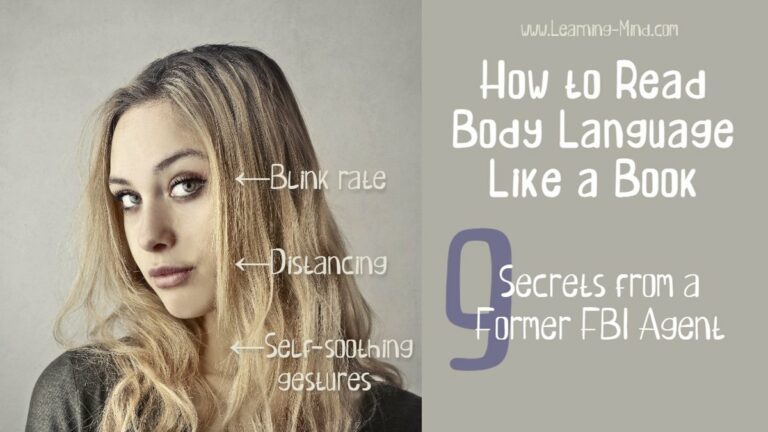
How to Read Body Language Like a Book: 9 Secrets Shared by a Former FBI Agent

How to Read Body Language Like a Book: 9 Secrets Shared by a Former FBI Agent

By Janey Davies, B.A. (Hons)

Post on February 20, 2023


Programmes such as Criminal Minds, Faking It–Tears of a Crime, and FBI Most Wanted have brought profiling body language into the mainstream. We all think we know how to read body language. But if I asked you to give me three signs that someone is lying, what would you say? Studies show that only 54% can accurately detect a lie.

So, perhaps we should look to people who are not only experts in body language, but have developed ground-breaking techniques in the science of detecting deception.

LaRae Quy worked in counterintelligence and as an undercover FBI agent for 24 years. Robert Ressler and John Douglas created criminal profiling based on body language and behavioral traits. And the UK’s Cliff Lansley examines the tiny body movements that show deception.

I’ve taken tips from LaRae Quy along with my other experts and here are their top secret tips.

How to Read Body Language: 9 Secrets from the Experts

Knowing how to read body language involves looking and listening for deviations, clues, and movements that give away our thoughts. Let’s start by looking.

1. Watch for normal behavior

How can you read body language when you don’t know the person? By looking at how they behave under normal conditions. Profilers call this ‘creating a baseline’.

For example, you have a friend that is excited to see you. One day she suddenly snaps at you in anger. She has deviated from her normal behavior/baseline. You immediately know that something is wrong. You can use this awareness when dealing with people you don’t know that well.

Building up a picture of how a person behaves when they’re not stressed is important. Once you know how someone acts when they are not under stress, it’s easier to spot when they are stressed.

2. What is the person doing differently?


Meeting someone for the first time, and talking about general topics like the weather, should not be stressful. As you chat, watch how they act. Are they talkative? Do they use a lot of hand gestures? Do they make good eye contact? Are they naturally fidgety or restrained in their movements?

Watch for changes when you move to a difficult topic. Have normally loud people suddenly gone quiet? If they usually look you in the eye, has their gaze deviated? Does the typically gesticulating person now have their hands in their pockets?

Now look for ‘tells’.

When we are under stress, our bodies give away clues or ‘tells’ indicating deception.

3. Blink rate

People think that direct eye contact is a good sign of telling the truth. However, it’s not so much eye contact but the blink rate that is important.

Body Language expert Cliff Lansley introduced us to the term ‘micro expressions’ where the body ‘leaks’ tiny gestures that belie our deception. People blink around 15–20 times a minute.

Blinking is an unconscious action. Some people think liars look away when they’re not telling the truth. Liars tend to stare whilst they are lying to convince you they are telling the truth.

However, watch for their blink rate. Studies show rapid blinking before or after talking is a sign of stress. No blinking, while they are staring at you, is also a sign of deception.

4. Mismatched synchronicity

If you want to know an easy way of reading body language, then just watch when people say yes or no. When we say yes, we nod our heads. Likewise, when we say no, we shake our heads. If the spoken yes or no matches our head movements, it is a reliable indicator we are telling the truth.

However, if the words and actions are not simultaneous, there is no synchronicity with what we are saying. It is a sign we have no confidence in what we are saying. Similarly, if we say yes and shake our heads or vice versa, this indicates lying.

5. Self-soothing gestures


Gestures such as stroking your legs, arms, hands or hair are called ‘self-soothing’ and can be a sign of deception.

You often see suspects in police interrogations rubbing or massaging parts of their bodies. They may even hug themselves by wrapping their arms around their body. Self-soothing gestures are exactly that; the person is comforting themselves because of an increase in stress.

Now let’s turn our attention to listening. Learning how to read body language isn’t just about watching people’s movements. It is also about the words and structure of what they say.
6. Qualifying language

Qualifiers are words that intensify or diminish another word. Criminals often use qualifiers to try to convince us of their innocence. Words such as honestly, absolutely, never, and literally bolster what we are saying.

If we are telling the truth, we don’t need these additional words. We use qualifying words and phrases as a convincing tactic to get others to believe us.

For instance:

“I swear to God.” “I honestly would not do that.” “I absolutely was not there.” “On my children’s life.”

There are also diminishing qualifiers such as:

“To the best of my knowledge.” “If I recall correctly.” “As far as I know.” “Honestly? I’m not sure.”

7. The linear narrative

Detectives use a brilliant question when starting off interviews with potential suspects:

“Tell me in as much detail as possible what you did yesterday, starting from when you got up.”

If you don’t know what you’re supposed to be looking for, this can seem like an odd tactic. However, detectives and FBI agents know something we don’t. But first, let’s look at an example.

You have two suspects; each one must account for their whereabouts the day before. One is telling the truth, and the other is lying. Which one is lying?

Suspect 1

“I got up at 7 am, went and had a shower. Then I made a cup of tea, fed the dog, and ate breakfast. After that, I got dressed, got my shoes and coat on, picked up my car keys, and got into my car. I stopped at a convenience store; it was around 8.15, to buy something for lunch. I arrived at work at 8.30 am.”

Suspect 2

“The alarm woke me up, and I got up, had a shower and got ready for work. I left at the usual time. Oh, hang on, I fed the dog before I left. I got to work a bit late. Yeah, I hadn’t made any lunch, so I stopped at a convenience store to get some food on the way there.”

So, have you guessed who is lying? Suspect 1 gives precise details in a linear timescale. Suspect 2 seems to be vague in their descriptions and their timeline goes backwards and forwards.

So, who is telling the truth?

The reason experts ask for a story-line of events is that when we lie, we tend to give our description of events in a linear narrative. In other words, we describe the start to finish, typically with exact times, and do not deviate from this start-to-end story-line.

As it is harder to remember a lie, we must cement that lie within an immovable structure. That structure is the defined linear start-to-finish story.

When we tell the truth, we jump all over the place, time-wise. This is because we are remembering events as we recall the memories in our minds. Some events are more memorable than others, so we recall them first. It is not natural to remember in a linear way.

So, listening to the story is important when you are learning how to read body language.

8. Nondescript descriptors

If I asked you to describe your kitchen, you’d be able to do it easily.

You might say that it is a galley-shaped kitchen with a low chef’s style sink next to a window facing the back garden. It has a minimalist look to it, as you don’t like clutter. The colors are grey and silver; the floor is linoleum, but it looks like tiles in a square, block pattern, and you have black appliances to match.

Now imagine you need to convince me you have stayed in a hotel room you’ve never seen before. How would you describe that room, if you had never been in it?

Your descriptors would be vague, without much detail. For example, you might say that it’s a typical hotel room layout. The bed was comfortable; the facilities are okay; you don’t mind the view and the parking was convenient.

See how the two descriptors are different? One is full of rich imagery, and the other is vague and could be applied to almost any hotel room.

9. Distancing tactics


It’s not natural to lie. We find it difficult, so we use tactics that make lying easier. Distancing ourselves from a victim or situation eases the stress of lying.

Remember Bill Clinton declaring:

“I did not have sexual relations with that woman.”

Clinton is distancing himself when he calls Monica Lewinsky ‘that woman’. Criminals often use this tactic in interrogations with the police. They will not use the victim’s name, substituting he, she, or them.

In another example, a BBC interviewer asked Prince Andrew about a particular event and he replied: “Didn’t happen.” Notice he did not say, “It didn’t happen.” By omitting ‘it’, he could be referring to anything.

Conclusion

I think knowing how to read body language is like having a superpower. You can evaluate people and situations by getting inside their minds without them knowing.

References:

Janey Davies


Sub-editor & staff writer at Learning Mind
Janey Davies has been published online for over 10 years. She has suffered from a panic disorder for over 30 years, which prompted her to study and receive an Honours degree in Psychology with the Open University. Janey uses the experiences of her own anxiety to offer help and advice to others dealing with mental health issues.