Showing posts with label human brain. Show all posts

Friday, July 18, 2025

The Brain’s Design; Why It Does Not Hold All the Data There Is

The Brain’s Design; Why It Does Not Hold All the Data There Is

By Neale Donald Walsch

Posted on July 18, 2025


Nothing is accidental in our universe. Nothing is a mistake or an unfortunate condition. This is what is meant by Intelligent Design. Everything that exists has emerged from Divine Intelligence. There is no conflict between Creationists and Evolutionists. Evolution is simply part of the Process of Creation, and all the conflict that seems to exist over the question of whether life ‘evolved’ or was ‘created’ seems to be “much ado about nothing.”

The human brain was designed (evolved) in a way that does not give it the capacity to hold all the data in the universe. That is not its design function. It is the design function of Consciousness to hold all the data in the universe. It is a design function of the brain to hold sufficient data to get through This Moment Now.

The brain is a mechanism and must not be confused with the Mind. The Mind is where Consciousness resides. It is one-third of the Three-Part Being that we are. Each of us is composed of three aspects or elements: Body, Mind, and Spirit. Consciousness resides in all three aspects.

The Body, the Mind, and the Spirit all hold all the data of the universe. Indeed, they are all the data of the universe, compressed into one location.

Did you hear that? Did you “get” that? Don’t just read right through that sentence and move on. Read it carefully, and consider its implications.

The Body, the Mind, and the Spirit all hold all the data of the universe. Indeed, they are all the data of the universe, compressed into one location.

Put into other words: The Being that you are is a microcosm of the macrocosm that we call the universe. Traditional theology says this yet another way: “You are made in the image and likeness of God.”

The words are more poetic, perhaps, but they mean precisely the same thing.

The brain is a mechanism uniquely designed to block from our present awareness all that the Body, Mind, and Spirit knows.

You may not have ever thought of it that way, but that is what is actually happening. That is the function of the brain.

The brain is a Data Filter and Organizer. It takes the data that flows to it through the extraordinary senses of the Body, through the unlimited vision of the Mind, and through the total awareness of the Spirit, then organizes it and filters it in a most unusual and efficient way…

First, it reduces the data to its countless component parts.

Second, it sorts those parts into categories, labeled Necessary and Unnecessary in the Present Moment, then eliminates all data deemed Unnecessary for comprehension of, or survival in, the Moment at Hand.

Third, it analyzes all data that it has deemed Necessary for the Moment at Hand and brings its analysis to your attention and your awareness. (These two are not the same thing. “Attention” allows you to notice something, “awareness” allows you to understand all of its implications. This is the difference between noticing and comprehending.)

Fourth, it separates our awareness into at least two parts. This is what makes it possible for one part of your brain to allow another part of your brain to “think about what you’re thinking about.” Part One of your Awareness analyzes and presents the Necessary Data, and Part Two considers the data being presented, reflects upon it, accesses other data previously stored by the brain (see below), and makes a decision about what it chooses to do in the Moment at Hand.

Fifth, it takes all the data that it deemed Necessary for the Present Moment, combines it with information on how that data was used, and stores it in its databank, in the form of what we call Memories. It calls upon this data in facilitating Future Moments.

The reason that the brain was designed to perform these functions is elegant. If the brain was simply a wide open receptor, a huge retainer of all the data that exists in the universe, it would be redundant and without separate purpose or function. As already noted, it is the purpose and function of Consciousness to retain all the data of the universe, not the purpose and function of the brain.

The purpose of the brain is to act as a mechanism with which we can use the limitless data of the universe, bit by bit. This broken-down data is utilized in the formulation of “reason” and the producing of “action”, through which we render ourselves capable of knowing and experiencing, expressing and fulfilling, becoming and expanding Who We Really Are.

In short, the brain is a tool — a magnificent, wondrous, extraordinary device — designed to intake, call up, analyze, and store the limitless data of the universe as it presents itself in any given moment, in order that Eternity may be experienced as Now, Everywhere may be experienced as Here, and Infinity may be experienced as This. Thus we can experience THIS, HERE and NOW. Thus we can discern discrete elements of, and encounters with, All That Is through an elegant mechanical process that allows All That Is to be known by Itself experientially.

Think of it this way: The brain acts as a dam on the flow of Consciousness. It creates power by conserving energy, holding it back and allowing it to flow in measured amounts.

Now when we experience a moment of expanded awareness, all that has happened is that we have immersed ourselves in the rushing waters of Everything, diving to the depths of Everywhere, and swimming in the currents of Infinity. In such moments you escape the boundaries of physicality, shifting your point of view from that of the brain to that of Consciousness, and expanding your awareness of the Ever Present Reality of God and of the True Nature of All That Is.

In such moments you have completed the journey, from Knowing to Experiencing to Knowing again, and reside in a pure State of Being, in which you both know and experience Who You Really Are.

And that is the Reason and the Reality: A brief explanation of Life and how it works.

But wait. There is more…next week, as we conclude this extended series of commentaries.

With Pure Love,


Neale Donald Walsch


© 2025 ReCreation Foundation – http://www.cwg.org – Neale Donald Walsch is a modern day spiritual messenger whose words continue to touch the world in profound ways. His With God series of books has been translated into 27 languages, touching millions of lives and inspiring important changes in their day-to-day lives.

Sunday, November 3, 2024

Whole Brain Thinking

Whole Brain Thinking

by Owen Waters

Posted on November 3, 2024


Do we still have unimaginable potential just waiting to be unlocked?

When you examine the functioning of the human brain, the answer is a resounding, “Yes!”

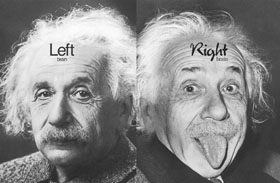
The human brain includes right and left hemispheres. These operate in different contexts as they perform different functions. In most people, the left hemisphere is primarily detail-oriented, while the right hemisphere is visually oriented and recognizes patterns.

The right hemisphere recognizes the picture, the overview or the context, while the left brain translates that image into words. When you look at a person who seems to be someone you knew a long time ago, you recognize the pattern of that person’s face long before their name catches up. You move in for a closer look, while trying not to stare, and your left brain is thinking, “Oh, that’s um, oh… I’ll never forget, um, what’s-his-name.”

The detail-oriented, left-brain hemisphere provides these functions:Logic.
Sequential perception.
Rational analysis.
Precision.
The sense of time passing at a fixed speed.
The translation of visual images from the right side of the brain into words.

The pattern-recognizing, right-brain hemisphere provides these functions:Spatial awareness – the ability to imagine, and operate within, three-dimensional space.
Whole picture overview – the recognition of patterns of light, sound or thought.
Dealing with thoughts in their natural, symbolic form.
Artistic ability – visual imagery.
Musical ability.
Memory.
The experience of emotions.
The dream state.
The reception of intuitive impressions.

In education, the left side of the brain is promoted much more than the right. Much attention is paid to arithmetic and word skills, while art and music receive little, and intuitive development doesn’t get any.

When you drive at a constant speed, your right brain, with its spatial awareness, monitors the road ahead for pattern changes. If you engage in a conversation while driving, using left-brain word skills, and something in the traffic pattern requires your attention, you have to switch your primary focus over to your right brain in order to deal with it. This explains why conversation stops as you attend to making a turn. The turn doesn’t require that much attention, but it does require a whole switch of brain sides, so the conversation stops for that short time.

Music naturally resonates with the right side of the mind. Did you ever sing along with a Golden Oldies song, one that you hadn’t heard for years?


Weren’t you amazed at how many of the lyrics you remembered? How could you possibly roll out, from memory, line after line of lyrics that you hadn’t heard in years? The answer lies in the right brain, where music is experienced and, also, memories are stored. You never had to use your left brain to laboriously remember the lyrics. When you heard the songs, they played into your right brain and were automatically stored in your right-brain memory, waiting to be recalled, sometimes decades later.

Right-brain development can include artistic and musical ability, which can be used to make your immediate surroundings look and sound beautiful.

To see how art skills turn on the right side of the brain, try drawing a picture of your left hand, only without looking at the paper you’re drawing on. As your right hand draws the outline of your left hand on paper, there will be a point at which your thinking flips over to the right brain. You’ll probably start the drawing in a linear style that prefers simple, straight lines, then suddenly switch to a more complex style that sees all the slight curves and details, appreciates their beauty, and starts to include them.

Quality of life can be enhanced enormously with more right-brain attention. Imagine, the luxury of living in a world where communities are designed to calm your senses and inspire you with the sights, sounds and smells of a beautiful environment.

Your spiritual connection is developed through the right side of the brain. Meditation provides inner peace and the development of intuition, which, in turn, provides necessary insights into your life’s path.

As right-brain activity is enhanced, your normal functioning becomes more whole-brain, and both hemispheres begin to be used in balance. The two hemispheres of the brain are connected by a large band of nervous tissue called the corpus callosum. This connecting band of tissue is larger in women than in men, raising the question,

“What are women known for having more of than men?”

Now, there could be many lighthearted answers to this question – abilities like perseverance while shopping, holding long, meaningful conversations, and – most of all – being able to ask for directions when lost!


However, the biggest difference is women’s intuition. It’s not that men don’t have intuition, it’s just that women tend to have more of it.

In order to develop our latent abilities, and our spiritual potential, we need to feel our way into a deeper experience of that feeling-oriented, right side of the brain, just as we have thought our way into developing the word-oriented left side of the brain.

We need to become more accustomed to using the language of the right side of the brain. The right brain uses symbols and pictures, not words. Symbols can be visual, and they can be complete information packets – thought balls, which are whole pictures containing thoughts and feelings.

To operate in the right brain means to grasp concepts without words, feeling them, knowing them, letting the left-brain logic wait until our sense knowingness has had the chance to become more than it was before.

If you are new to the art of paying attention to your intuition, then you will need a little practice before proficiency is achieved. Your initial attempts may seem like failures, but that’s only to be expected at the outset.

Practice by being receptive to the “still, small voice within” of your intuition. The more you pay attention to your intuitive insights, the more you grow to realize how profoundly correct they are.

Practice makes perfect, and a you’ll achieve good results a lot sooner than you might expect. Just keep track of all your insights and, with a little dedicated practice, you’ll be amazed at their accuracy.

Owen Waters


Monday, June 19, 2023

Despite the Hype, Artificial Intelligence Remains Inferior to the Human Brain

Despite the Hype, Artificial Intelligence Remains Inferior to the Human Brain

By RT

Posted on June 19, 2023


With new alarming predictions being made every week, it is important to explore the limitations of AI. The human brain provides the best reference point.

The global infoscape is currently abuzz with alarmist predictions over the dangers posed by artificial intelligence (AI). Billionaire entrepreneurs and their hirelings, who had once gushed over the emerging AI “technopia”, have suddenly turned apocalyptic. As the narrative du jour goes, a sentient AI may ultimately turn against its creators.

But are there any merits to this claim, apart from fictional cues from the Terminator franchise?

One way to answer that question would be to compare AI to an analogue that is already available and sentient, namely – the human brain. AI was designed not only to mimic the human mind but also to out-compute it in certain aspects. Apart from presenting a paradigm shift, AI’s utility is not entirely revolutionary. Rather, it is a continuation of innovations past and present – wheels, cranks, and windmills to surmount our limbic limitations; bows, arrows and missiles to counter remote threats; and the Internet to resolve space-time constraints in (global) communications.

According to a notable article in the Foglets, “it is postulated that the human brain operates at 1 exaFLOP, which is equivalent to a billion calculations per second”. Mind you, this is just a postulation – a guesstimate likely defined by computing metrics. At the time of writing, Frontier, the world’s fastest supercomputer, reportedly operates at a speed of 1.102 exaFLOP. The difference between the brain and the supercomputer, however, lies in nature and function: one thinks while the other analyses data.

We have invented supercomputers to crunch numbers, but our scientists remain baffled by the neural processing prowess of human calculatorsShakuntala Devi, who grew up in a circus environment, was one prime example. Our sophisticated machine-mediated models still cannot fully comprehend how these brains work, beyond the fact that there is an atypical increase in blood flow to particular cerebral lobes when computational tasks are performed. The rest is a plane of scattered studies, suppositions, and data that have yet to be reconciled into a comprehensible whole.

There are too many unknowns with regards to the human brain. This may be the reason why the scientific community casually divides its major functions into eight or 12 primary categories. Where sentience lies within these categories remains an open question. Maybe, it is the result of cumulative interactions between all of them. Or maybe, humans have a sentient soul that makes them innovate in a way inaccessible to other species? Maybe, unlike AI devices and algorithms, the brain is software and hardware rolled into one? Too much uncertainty remains.

If neuroscience is an inchoate field riddled with myriad questions and gaps, what of its simpler subset – artificial intelligence? Can an embryonic technology invented by humans suddenly spring to life and threaten mankind? If we cannot fully understand how the human brain works or even define sentience, why are we cutting and pasting plots from sci-fi flicks onto our reality?

There is a hypothetical chance that artificial intelligence does pose a real threat within a narrow spectrum. Poor software designs, rushed developmental processes and mismatched updates to algorithms, among others, can lead to various disaster scenarios. Those involve incidents at chemical or nuclear plants, on the stock market, or with experimental self-driving vehicles. But the prospect of an ominous, sentient AI is an imaginary proposition altogether.

The current fad in AI alarmism may actually be rooted in something more venal and down-to-earth. For it may not be machines that will ultimately revolt against its masters, but rather the hundreds of millions of workers – perhaps billions – who will be displaced by AI before this decade is out. This topic deserves a dedicated commentary on its own, and the human brain provides a reality check to the supposed existential threats posed by AI.

Wonders of the human brain

The nm.org resource provides the following snippet on our thinking organ and its processing capabilities: A fragment of brain tissue the size of a grain of sand contains 100,000 neurons and 1 billion synapses. The brain can generate about 23 watts of power – enough to power a light bulb. Information travels up to an impressive 268 miles per hour, while its storage capacity is considered virtually unlimited. Research suggests the human brain consists of about 86 billion neurons. Each neuron forms connections to other neurons, which could add up to 1 quadrillion (1,000 trillion) connections.

No wonder the Psalmist exulted in the fact that he was “fearfully and wonderfully made” in “his mother’s womb”. At any one second, the brain coordinates a bewildering variety of functions within itself and the human body in order to maintain organic harmony. It also rapidly compensates any deviation from the norm within the body in the event of a disruption i.e. shifting balance to one leg after another is impaired or activating hemostasis upon bleeding. The human body is therefore the ultimate complex adaptive system (CAS).

While the body’s CAS functions are too vast and technical to be enumerated here, there are some worldly examples on how the brain contrives to protect its host. When you have a “pain in the neck” in a vexatious social setting, that is your brain sending an instruction via your body to seek the nearest exit, thereby avoiding a more serious condition. When you are suffering from snowballing intellectual torpor or depression, that may be the brain’s way of warning you to avoid fake news and the fools who peddle them.

Traffic test: human brain vs AI

While the brain generates 23 watts of power, the Frontier supercomputer consumes a whopping 21 megawatts (MW). One megawatt is one million watts. The energy factor alone is a reason why scientists are betting on biological computing as the next great technological frontier. Until then, we need to put up with hardware and software that still cannot match the human brain in relatively simple situations.

I often use the following traffic example to demonstrate the contrasting capabilities of the human brain and AI. Two cars are approaching a narrow choke point in opposite directions. There is heavy rain and wind outside. Car A is traveling twice as fast as Car B, but the distance to the choke point is twice as long for the former. Both drivers realize that, under normal conditions, Car B should speed up to exit the narrow strip. However, there is a large puddle of water in front of Car B, hinting at a risky pothole underneath. Both drivers instinctively realize that it is then better for Car A to exit the choke point first and thereby free up space in the adjoining lane for Car B to avoid the puddle. This is called situational awareness. The brain negotiates complexities like these without breaking the proverbial sweat – second after second!

Now, replace the drivers with autonomous driving systems and imagine the amount of energy and the scale of technological infrastructure needed to perform a similar task? The cars would need GPS navigation and weather updates, satellite and 5G connectivity, and a host of sensors. Satellite navigation may fail during a storm. So what should these ‘intelligent’ vehicles do? Stay put and halt traffic? Or seek a curb that is rapidly becoming muddy? Our human tactile senses would know when to accelerate out of a slippery situation, but self-driving cars would need a staggering array of hardware and algorithms to cope.

Now, imagine a billion cars operated by autonomous driving systems. How will the energy and computing power for this infrastructure be generated? Would a proverbial Death Star suffice, albeit for our collective benefit?

Maybe, this is the conundrum that keeps AI alarmists awake at night? The AI technopia they envisage cannot support a global population of one billion, let alone the eight billion we have at present.

In fact, according to the celebrated techno-prophet Yuval Noah Harari, the “big political and economic question of the 21st century will be what do we need humans for, or at least what do we need so many humans for”?

Now, if that does not send an existential chill down your spine, I don’t know what will.

RT

Source