Experts often don't agree, we're drowning in information, and censorship is a very real thing - here's how to not get lost and confused navigating information.
Set Your Pulse: Take a breath. Release the tension in your body. Place attention on your physical heart. Breathe slowly into the area for 60 seconds, focusing on feeling a sense of ease.
Click here to learn why we suggest this.
I wanted to present a quick collection of ideas, thoughts, and reflections that can act as tools for navigating the information landscape. It can be confusing out there, hopefully these tools make things easier.
I want to point out that we have the potential to live in a world where we would not have to have this level of discernment. It would be possible if we were less blinded by political ideologies, emotions, social media algorithms and censorship. But given this is the landscape we find ourselves in today, knowing how to weather the storm is essential.
1. Stay Present
This is first and foremost to me. Navigating our world and information has become purely cognitive. But we are not purely cognitive beings. We have gut and heart intelligence on top of our mental capacity, so why not bring it on board and master it?
Further, how we feel about something can give us insight into the beliefs, resistances, and emotions that may be shaping our perspectives.
How do we become aware of how we feel and activate our other forms of intelligence? By staying present and connected to our body.
Solution: Use the “Set Your Pulse” reminder we have above. It’s a fancy way of saying “take a breath and be human! You may have gotten lost in pure cognition. Come back to your body, to presence, and expand your consciousness a bit.”
It also won’t hurt to have some sort of practice that regularly teaches interoception, the ability to track your internal experience, sensations and emotions. Conscious breathing, somatic movement, yoga, and martial arts all build our interoception muscle. It’s a crucial aspect to exploring our world with clarity.
2. The Streetlight Effect
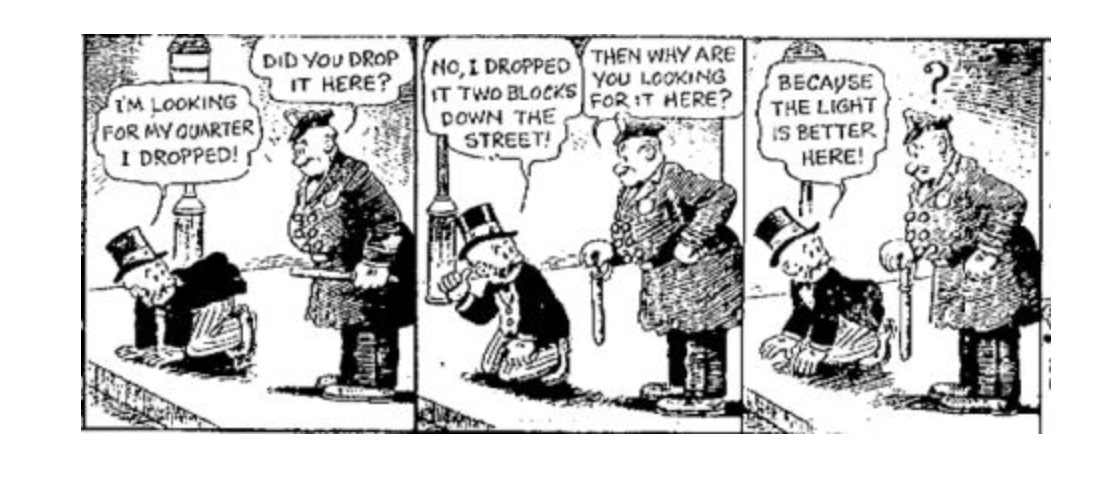
We can sometimes look for answers where it’s most convenient to, even if it’s a terrible place to look.
This one can be best summed up in a parable featuring the Seljuk Sufi mystic
Nasrudin Hodja. The Indologist Wendy Doniger quotes this parable in her book, The Hindus: An Alternative History.
Someone saw Nasrudin searching for something on the ground. “What have you lost, Mulla?” he asked. “My key,” said the Mulla. So they both went down on their knees and looked for it. After a time the other man asked: “Where exactly did you drop it?” “In my own house.” “Then why are you looking here?” “There is more light here than inside my own house.”‘
It’s funny, but what’s even funnier is how true this is today. People tend to search for answers where it is easiest to look. Whether it’s from the 1 or 2 news sources they follow, a 15 second reel, or a 2 minute clip that their friend sends to them that lacks important context.
Whatever is simple and easy can often be how opinion is shaped. Social media trends, best selling books, what the ‘experts’ are saying are a few of many examples. But just because it’s easy and it’s where everyone is looking doesn’t mean it’s the best approach.
Solution: Our world is complex. Be willing to read full articles, even multiple at times. Watch more than just reels, 15 second clips and shorts - you’re likely not going to learn much from these.
3. Epistemic Humility
Instead of trying to be right, try to be less wrong.
As Jose Medina writes,
“When not taken to the extreme, attentiveness to one's cognitive limitations does not undermine one's confidence and erode one's character (that is, when it does not become pathological), epistemic humility can afford great benefits. Having a humble and self-questioning attitude toward one's cognitive repertoire can lead to many epistemic achievements and advantages.”
The key here is, you don’t have to obsess over your own thoughts and cognition. After all, we are beings with gut and heart intelligence as well, but we should not neglect our thinking in favour of other intelligences.
It’s common for people to believe they can derive all they need to know from intuition alone - I don’t align with this idea. Intuition is incredibly important, but we have a brain, cognition, and complex thinking for a reason. We use it everyday, why not master it along with heart and gut intelligence?
Solution: Keep an eye on your desire to become certain about something. Be comfortable with being uncertain. Often times it is hard to know an absolute truth. It is better to understand how to be less wrong than trying to be absolutely right.
4. Be Aware of “Experts”
No, I’m not saying people can’t be experts. In fact, I think we need highly skilled and focused people like experts. But to me there are two reasons to think critically about what experts say:
For every PhD that is out there, there is another PhD that was granted proving the opposite thesis. This simply means experts can present conclusions that are the complete opposite to one another, and it’s not uncommon for experts to completely disagree.
People are people, yet it’s easy to forget that. When certain individuals have some letters after their name and rise up in the ranks of fame, we tend to not think as critically about what they have to say as we can become mesmerized by their ‘social proof.’
These people all poo and wipe their butt. This, of course, is a way of saying, they are human just like you and me. They are fallible and prone to having shortsighted views at times - especially as they get busier and busier in the unrealistic schedule that’s demanded of them in order to keep up with all of their fame. (And this is only one potential source of bias.)
In a world driven by trends, constant social media posting to stay relevant, and the need to have ‘a take’ on everything popular, the ecosystem of information incentivizes people to join conversations they know little about - yes, even the ‘experts.’
Solution: Be open to arguments from opposing experts. Don’t pedestal an expert or turn them into a guru. Remember, they may not have looked into something they post as deeply as you think. They are busy. Check out our
conversation on what to do when experts don’t agree.
5. Uninformed Opinions
One of the most common things I see today on social media and real life is people taking strong positions on things they haven’t considered deeply.
As someone who loves asking questions and understanding why people feel the way they do, when people claim strong positions on something I often dig deeper to understand how they arrived at their positions and what evidence, feelings, experiences, or intuitions might back it.
Sometimes people will smile and admit they don’t really know the subject too well. Others will repeat talking points they heard from their favourite presenter or someone at work. While others will lay out a really beautiful explanation to which we can discuss and build upon - which is a lot of fun.
Because people often don’t like changing their mind or feel embarrassed if they have to, taking strong positions without true consideration can be problematic.
Solution: Before taking a strong stance on an issue, check whether you have taken the time to inquire deeply on it. Have you listened to multiple sides and perspectives? Do you even need to take a STRONG stance right now?
6. Echo Chambers & Repetition
We’ve all see the mash up videos showing mainstream new sources saying the same key phrases over and over again, smashing home an idea and sentiment with repetition - even when the idea is not true or solid.
The truth is, I could make the same mash up videos with many indie news creators spouting equally incomplete information. Indoctrination occurs through echo chambers and repetition. This is done when creators of this content find news that will continue to fit their view, without honestly bringing up greater context or differing perspectives.
Solution: Regularly explore different news sources. I check out anything from alt sources to the New York Times, to the Atlantic etc. Clashing perspectives is healthy. Sure, you can set aside extreme voices if you like, but there are many grounded people sharing opposing arguments. Seek to understand them and integrate their experience of life. Doing this helps us become more resistant to being fooled.
The Pulse is a reader-supported publication. To receive new posts and support our work, consider becoming a free or paid subscriber.
7. Noble Cause Corruption
This is often seen in woke ideology, but isn’t uncommon in truth seekers and other circles as well.
Noble cause corruption is when people do bad things in the name of ‘good.’ ‘The ends justifying the means’ so to speak. People are convinced of their self- righteousness and will do anything within their power to get the result they want.
We saw this deeply with censorship during COVID. Good and intelligent people got caught in a place of being certain about what their governments and health authorities were saying. They also deeply believed in government propaganda that stated “those questioning things are bad.”
This led to the acceptance that people should be fined, jailed, censored, smeared, and become financially unstable. All of these means were justified by the end of stopping critical thought about COVID policy so people would ‘shut up and follow the rules.’
To be fair, some people were willing to publish false, sensational, and misleading information about vaccine injuries for ‘the greater good of waking people up’ as well. It’ sounds like a good idea at the time, but truthfully only hurts the cause. The ‘in crowd’ might like it, but everyone else only walks further away.
Generally, there is enough good and grounded information out there to invite people to open their minds.
Solution: Keep and eye on and reflect on self-righteousness and ideas that seek to control other people in the name of ‘the greater good.’ If we have to trick people or force people into accepting ideas, they probably aren’t well thought out and clear enough.
8. Our Preferences & Wishes
Sometimes when navigating information about a subject we might WANT or prefer something to be true. For example, we might prefer that Donald Trump is a bigger criminal than Hillary Clinton, so we might only look at information or evidence that suggests this to be true and ignore the rest or call it “conspiracy.”
Further, our desires make it so only a tiny shred of evidence is needed to prove the thing we want to be true, while mountains are needed to change our mind.
Notice this isn’t confirmation bias here. We’re talking about something deeper. A feeling, a desire, an emotion, something that is pulling at us for a deeper reason.
Solution: Notice your feelings. Notice your emotions. Notice the ways in which you might have resistances to certain outcomes and how quickly you disqualify some evidence while making tiny shreds into gold. See if you can strip your own desires and wishful thoughts out of the equation and explore more holistically.
You'll learn to see where your own bias' exist, and how to clearly see bias in other people, news articles, and in situations.